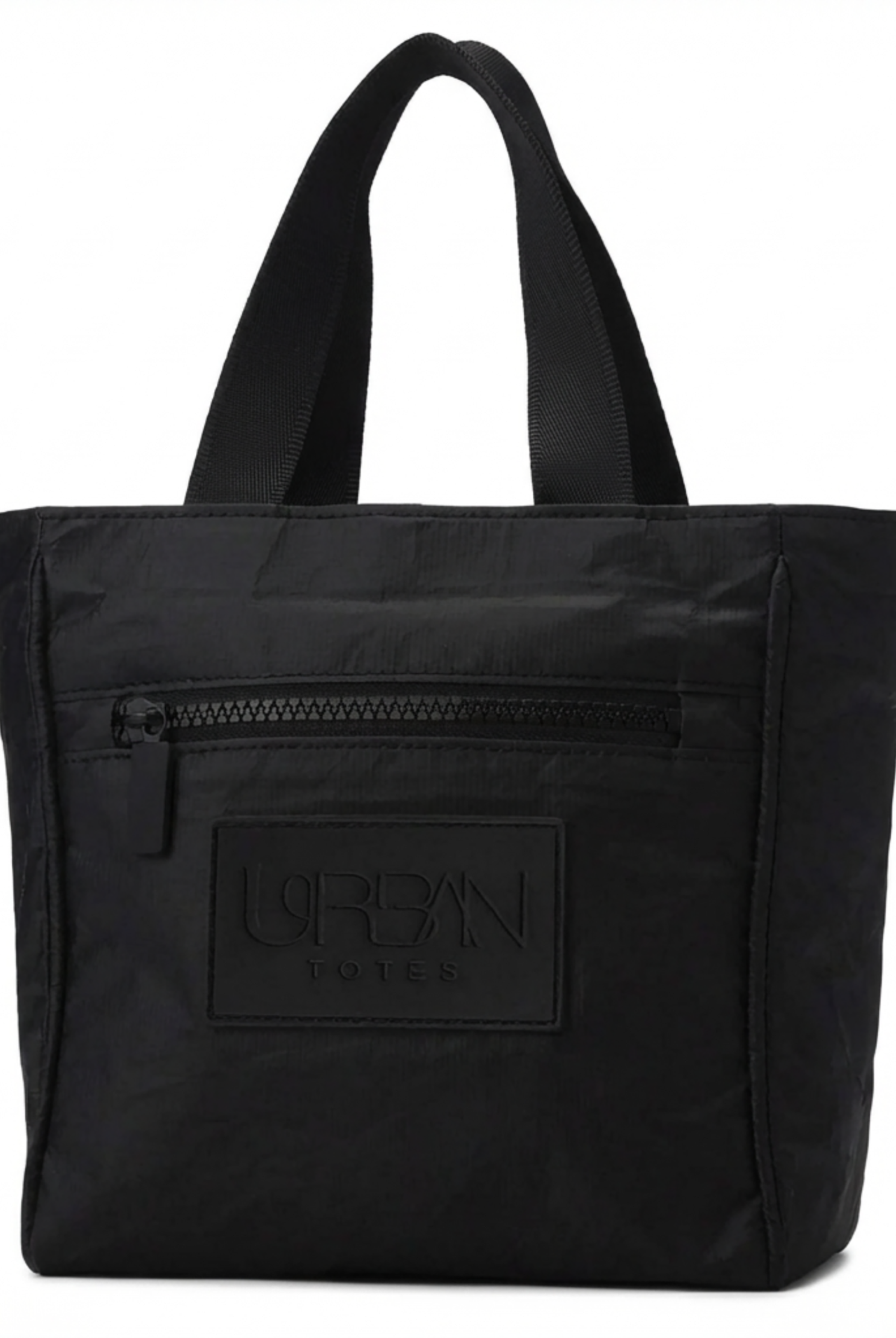
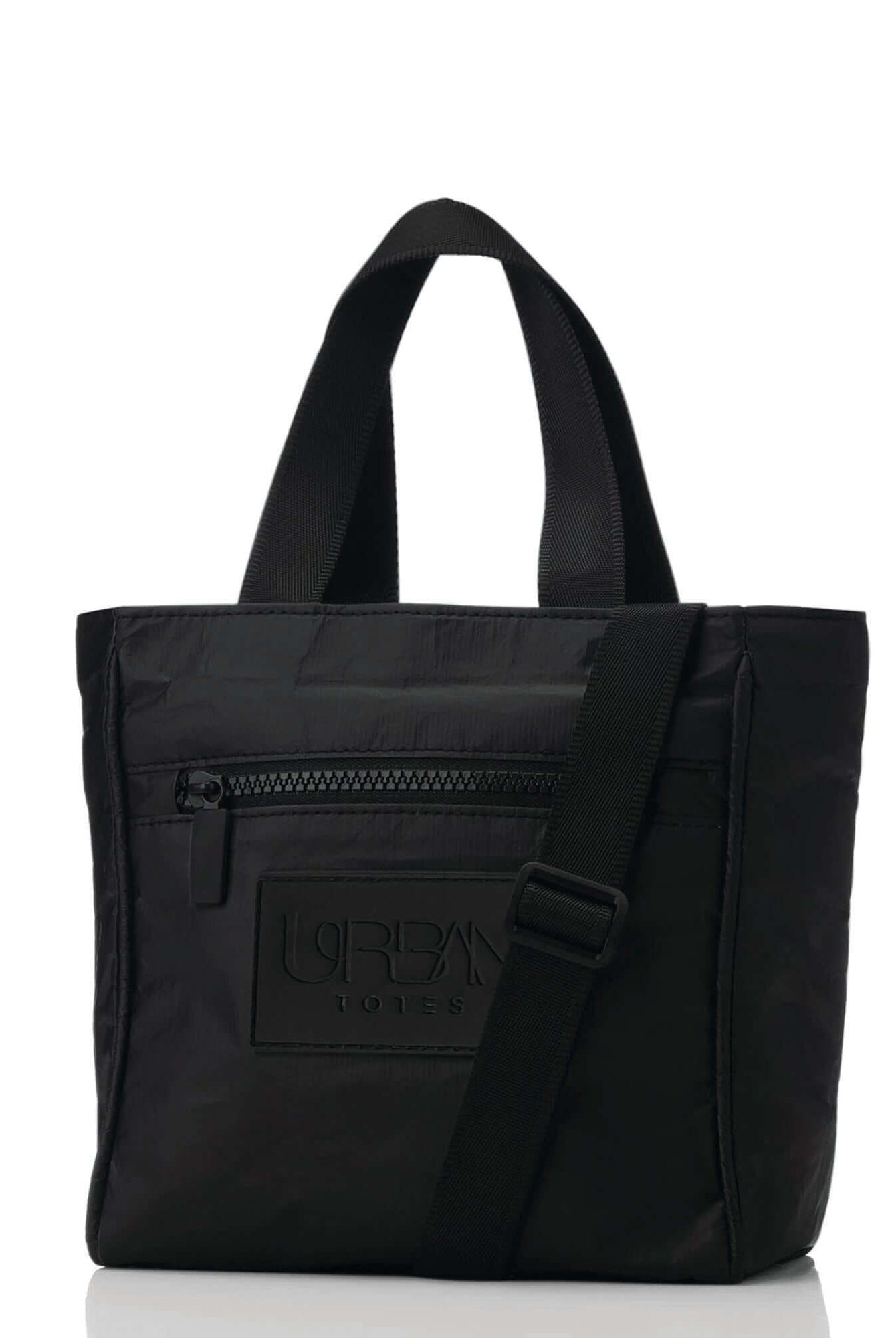
For broad U.S. airline compatibility, plan for an under-seat bag of roughly 17 × 13 × 8 inches, since American allows up to 18 × 14 × 8 inches while JetBlue caps at 17 × 13 × 8 inches and other carriers run tighter. That size gives you a practical starting point, but the packed shape and the operating airline's policy still decide whether your tote slides beneath the seat.
You're standing in the boarding line with coffee in one hand and a tote in the other when the sizing frame suddenly looks much less forgiving than it did at home. The bag seemed flexible, yet a laptop, shoes, and a full toiletry pouch have turned it into a stubborn rectangle. A few inches can determine whether you settle into your seat with your essentials nearby or rearrange your travel day at the gate.
Table of Contents
- The Short Answer on Under-Seat Bag Size
- Personal Item vs Carry-On Bag
- Airline-by-Airline Under-Seat Size Chart
- International Airline Rules and Weight Limits
- How to Measure Your Bag for Under-Seat Fit
- Everyday Comparisons for Under-Seat Dimensions
- Why Soft-Sided Does Not Automatically Mean Compliant
- Travel-Ready Totes That Fit Under the Seat
- Pre-Flight Quick Reference and FAQs
The Short Answer on Under-Seat Bag Size
No single universal personal-item size applies to every airline. For broad U.S. compatibility, approximately 17 × 13 × 8 inches is a conservative planning target, based on American's allowance of 18 × 14 × 8 inches and JetBlue's tighter limit of 17 × 13 × 8 inches. You can verify American's current personal-item policy through its carry-on baggage guidance.
That target isn't a guarantee of identical space under every seat. Aircraft layouts, seat configurations, bulkheads, and the position of support structures can change the usable opening. A soft, compressible tote with a compact base is usually easier to manage than a rigid bag that fills every edge of the stated allowance.
Practical rule: Choose for the tightest airline on your itinerary, then measure the bag after you've packed it.
The most useful way to think about this question is in three layers:
- By airline: Compare the operating carrier's personal-item dimensions, not only the ticketing site or the airline you used for booking.
- By measuring method: Include handles, exterior pockets, straps, and hardware that projects outward.
- By bag style: Look for a lightweight, flexible, organized tote that can compress without crushing the items inside.
A bag that works for an airport terminal may also become your everyday carry for school drop-off, a farmers market, or a beach day. Urban Totes' practical travel perspective pairs naturally with broader planning advice, and these 5 tips for air travel can help you prepare for the rest of the journey.
The guide below covers the difference between a personal item and a carry-on, a U.S. airline size chart, international weight rules, a reliable measuring routine, and the packing choices that change real-world fit. It also looks at travel-ready tote features, so you can choose something that works beyond the flight itself.
Personal Item vs Carry-On Bag
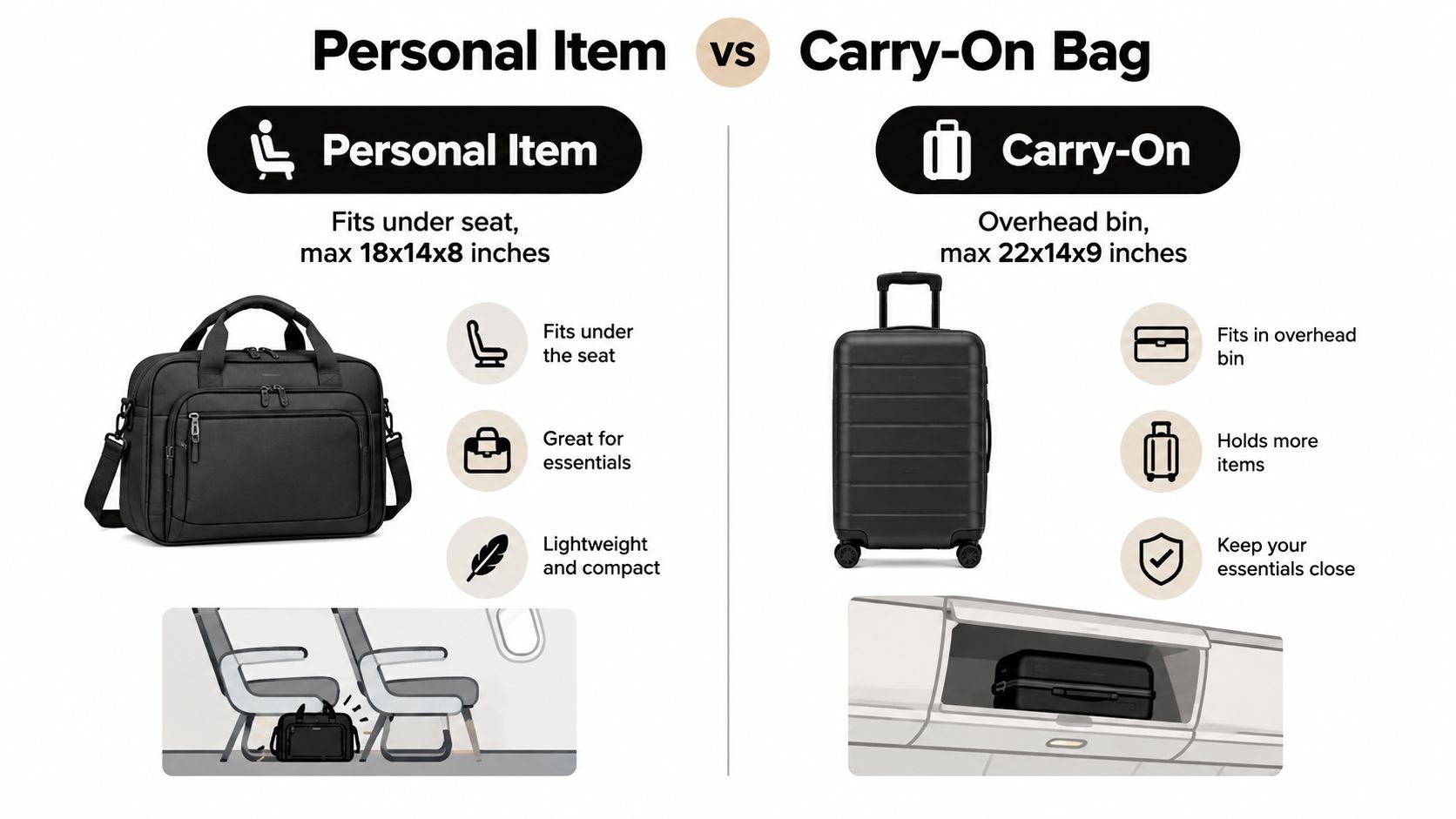
You reach your seat with a tote that fit easily through the terminal, then find its packed base will not slide under the seat. The problem is usually a category mismatch. A personal item uses the space below you, while a standard carry-on bag is sized for the overhead compartment.
The Federal Aviation Administration says a personal item may need to fit beneath the seat in front of you, particularly when overhead-bin space is limited. The FAA does not set one universal personal-item measurement for every airline. The commonly used overhead-carry-on benchmark is 45 linear inches, calculated by adding height, width, and depth. See the FAA baggage guidance for the official framing.
Use this simple comparison:
- Personal item: A compact bag intended to fit beneath the seat.
- Carry-on bag: A larger bag intended for the overhead compartment.
- Under-seat design: A flexible, soft-sided shape that can use a limited floor opening without rigid framing.
The seat-back pocket does not replace under-seat storage. FAA guidance does not approve seat pockets as a location for carry-on baggage, so the bag must stow fully beneath the seat, without blocking the space around your feet.
Airline rules vary, so do not choose from one universal “golden” size. Plan around the tightest limit on your itinerary, then measure the bag after packing. A dense laptop, pouch, or water bottle can make an advertised size irrelevant by pushing the sides outward.
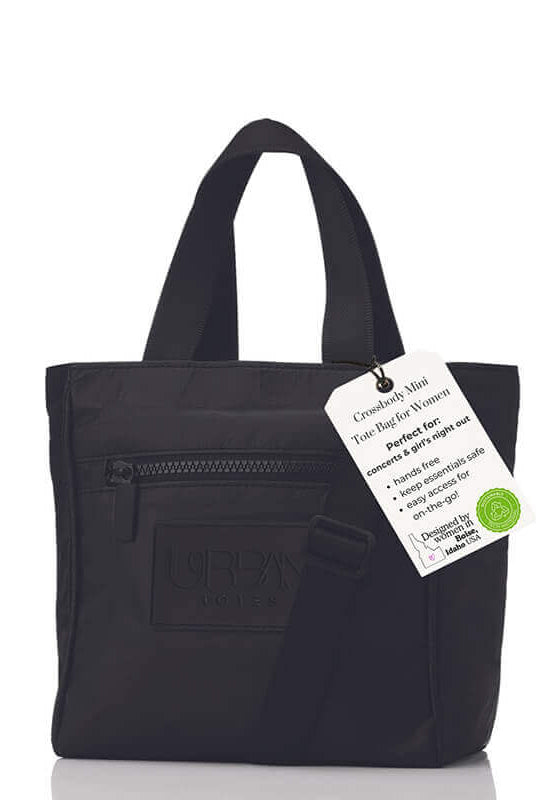
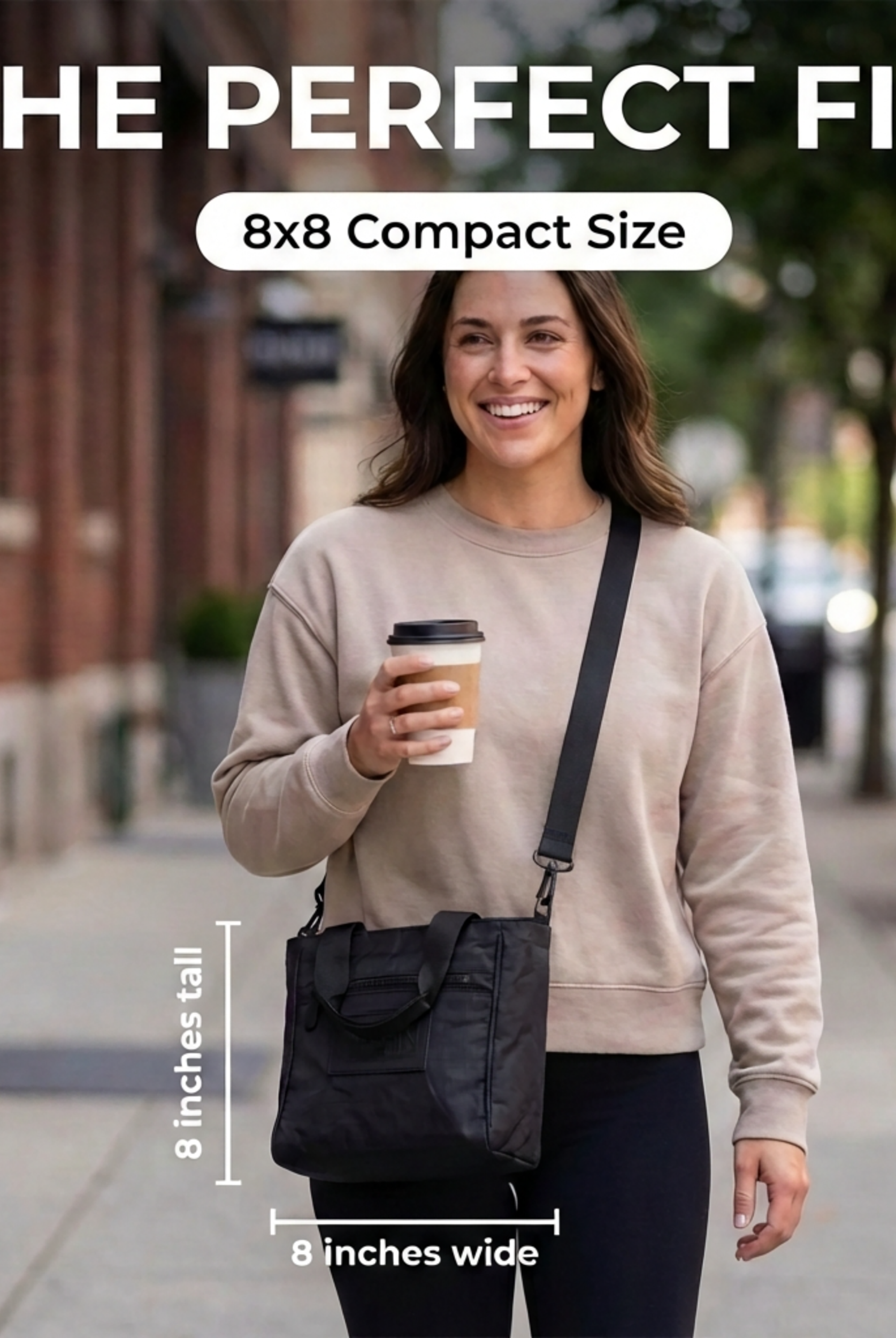
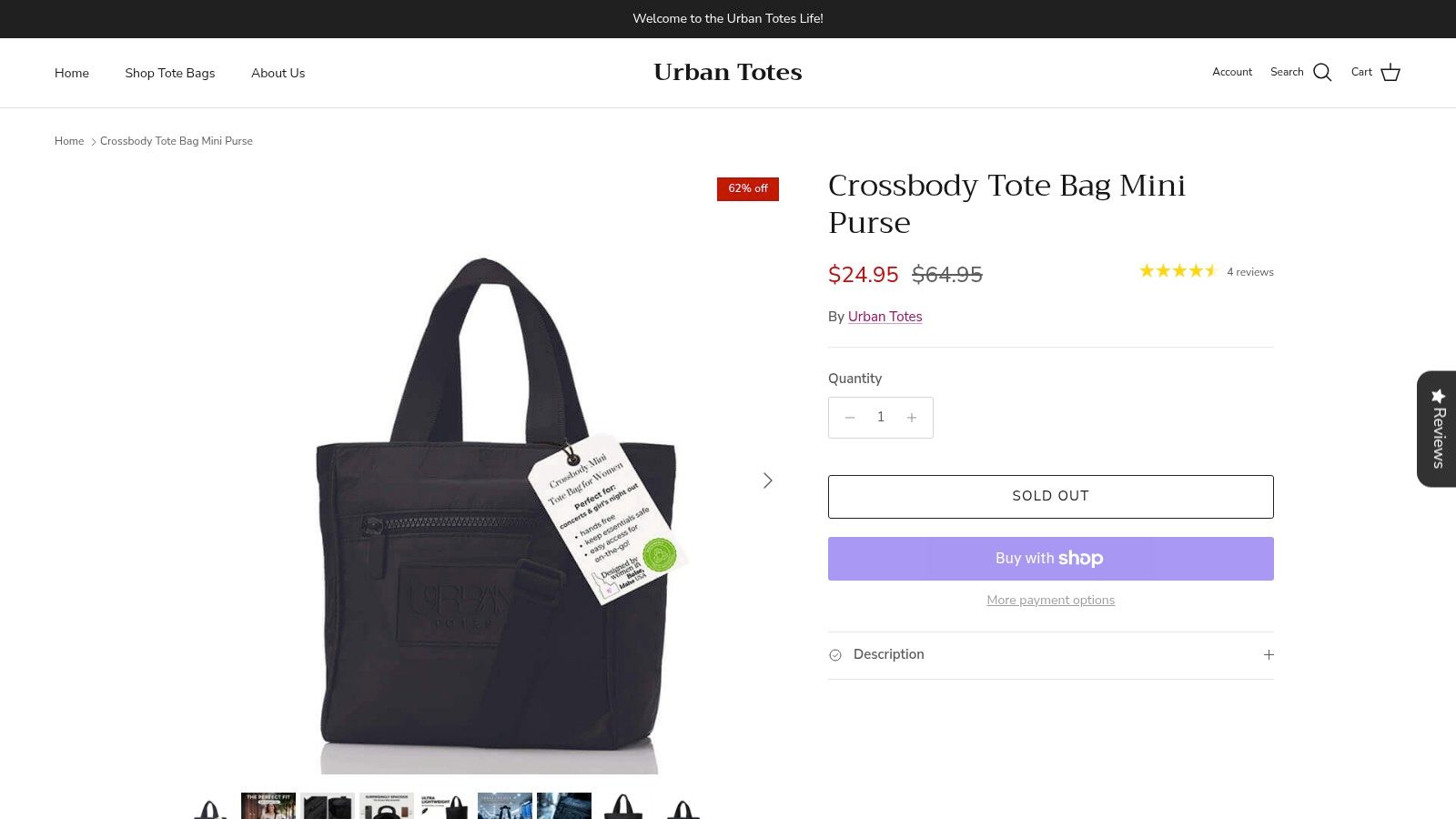
For small essentials, Crossbody Tote Bag Mini Purse (7.5 × 4 × 7.75 inches) has a zip-top closure and pockets for items such as a phone and keys. It can also organize smaller belongings inside a larger travel tote.
For a fuller category comparison, read Urban Totes' guide to carry-on bag versus personal item before shopping.
Airline-by-Airline Under-Seat Size Chart
Airline limits vary enough that a single “golden” dimension can create false confidence. The chart below highlights several U.S. personal-item limits and the shape of the space each one emphasizes.
| Airline | Max Personal Item Size (inches) | Notes |
|---|---|---|
| American Airlines | 18 × 14 × 8 | Larger upper benchmark among the examples |
| JetBlue | 17 × 13 × 8 | Tighter than American by 1 inch in length and width |
| United | 17 × 10 × 9 | Narrower footprint |
| Alaska | 17 × 13 × 6 | Shallowest depth in this comparison |
| Southwest | 16.25 × 13.5 × 8 | Shorter length than the other examples |
The figures for United, Alaska, and Southwest are reported in this personal-item size comparison. The difference between carriers can look minor on paper, but 1 inch in length or width can decide whether a structured tote slides under the seat.
United's 17 × 10 × 9 inches is the awkward one for broad totes. A bag built around a wider footprint may meet another carrier's rule but fail here because its base doesn't narrow enough. Alaska's 6-inch depth creates a different challenge. A tote can have a suitable length and width yet become too bulky front to back once a laptop sleeve or packed pouch fills it.
Southwest's 16.25-inch length shows why the largest allowance isn't always the safest target. A bag designed around American's larger length may need to compress or may not qualify on a tighter flight. If your trip includes several airlines, choose the smallest relevant footprint rather than averaging the rules.
Travelers carrying wheeled computer bags should also account for how wheels and handles affect the usable footprint. A practical overview of airline rules for wheeled computer bags can help you distinguish a personal item from a larger rolling case.
For soft weekenders and totes, dimensions are only part of the decision. Urban Totes' guide to weekender bag dimensions is useful when you're deciding whether a style belongs under the seat or in the overhead bin.
International Airline Rules and Weight Limits
International travel adds another variable: weight. A tote may fit into the available space and still exceed the airline's personal-item limit once it contains a laptop, chargers, water bottle, book, and travel essentials.
Turkish Airlines allows Economy passengers one personal item measuring up to 40 × 30 × 15 centimeters and weighing no more than 4 kilograms, alongside a separate cabin bag limited to 23 × 40 × 55 centimeters and 8 kilograms, according to its carry-on baggage policy. The policy also requires baggage to be sized and weighed so it fits either beneath the seat or in the overhead locker.
That example is substantially smaller than the broad U.S. planning target. It also shows why a lightweight tote matters when the airline checks both dimensions and packed weight. A flexible bag doesn't help if dense contents push the total load beyond the permitted limit.
Before an international flight, check two separate details on the operating airline's website:
- Personal-item dimensions: Confirm the length, width, and depth in the airline's stated units.
- Weight allowance: Check whether the personal item has its own weight cap or is covered by a broader cabin-baggage rule.
Don't assume that a U.S. domestic policy follows you across an international itinerary. The airline operating each flight is the one whose baggage conditions you need to verify.
How to Measure Your Bag for Under-Seat Fit
Measuring an empty tote at the kitchen table gives you only a starting point. Packing changes the shape, and the bag's exterior features can add usable bulk even when the fabric itself is flexible.
Start with the outside shape
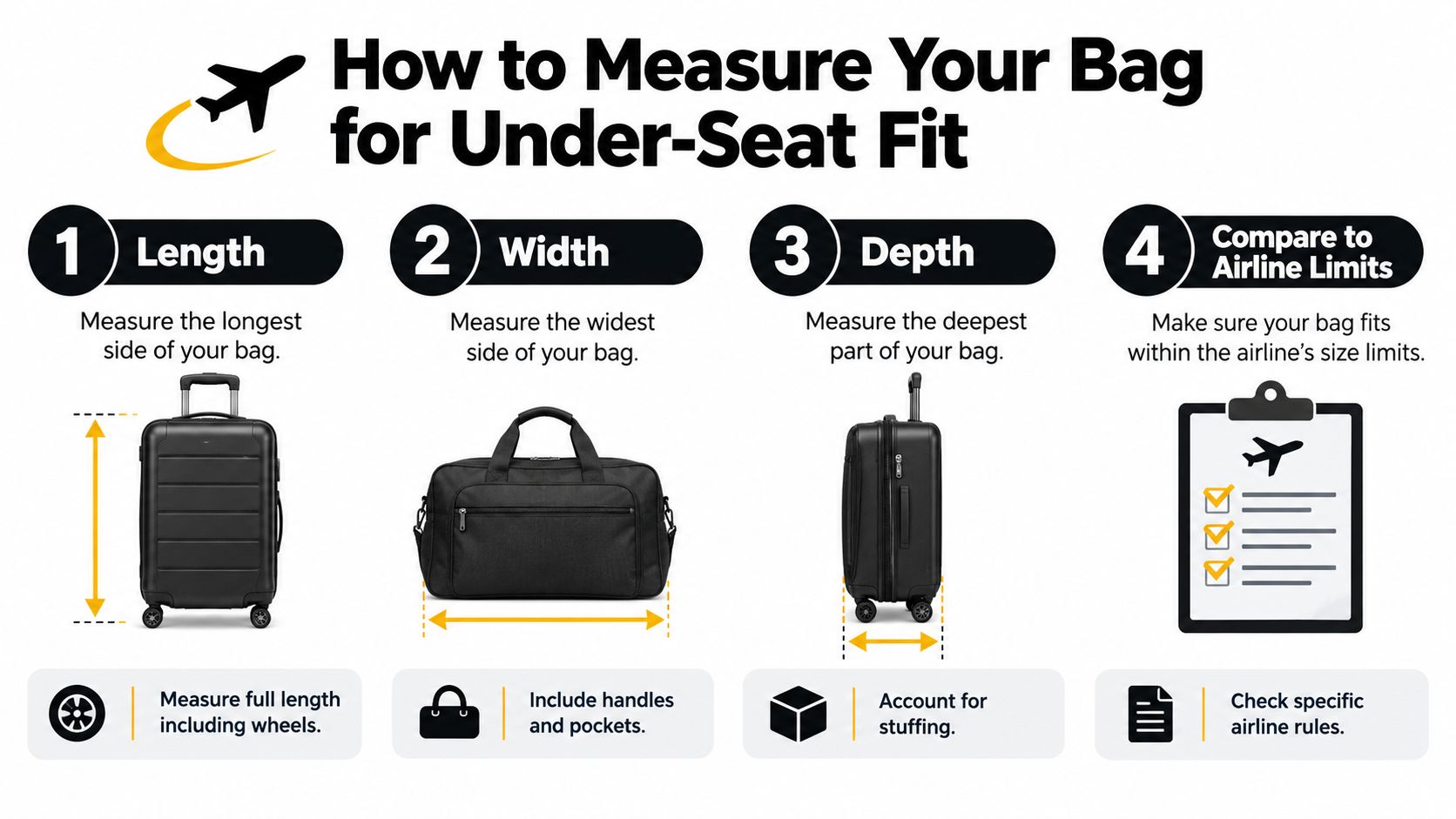
Place the bag on a flat surface and use a soft tape measure. Don't pull the fabric tight or press down on the sides. Measure the longest side, the widest side, and the deepest point as the bag naturally sits.
Include:
- Handles and straps: Account for anything that extends beyond the main body.
- Exterior pockets: A filled pocket can become the widest or deepest part.
- Zippers and hardware: Include buckles, piping, wheels, and other projections.
- Structured areas: Note sections that won't compress when the bag is pushed into a confined opening.
The International Air Transport Association notes that many airlines use a maximum carry-on size of 56 × 45 × 25 centimeters, including wheels and handles, which reinforces the need to measure every exterior component. That larger carry-on benchmark shouldn't replace the personal-item allowance when you're checking an under-seat tote. The IATA's passenger baggage rules provide useful context.
Pack before the final check
Put in the items you'll carry. A laptop, shoes, toiletry kit, camera, or structured organizer can create hard points that change the bag's dimensions. Measure again with the zipper closed, then check the most crowded side rather than relying on the manufacturer's empty-bag measurements.
For a final check the night before departure:
- Confirm the operating airline and personal-item limit.
- Pack the bag as you intend to travel.
- Measure length, width, and depth from the outside.
- Check projecting straps, pockets, and hardware.
- Leave a little flexibility instead of filling every available space.
If your bag relies on internal organization, a tote bag organizer with zipper can help keep small items contained, but make sure the organizer itself doesn't create a rigid block that prevents compression.
Everyday Comparisons for Under-Seat Dimensions
Numbers become easier to judge when you translate them into the objects you already carry. A conservative under-seat tote has a compact footprint, closer to a carefully packed personal-effects bag than to a roomy beach carry-all.
Think about the base first. A laptop should lie flat without forcing the sides outward, and a school folder should slide in without bending the tote's opening. A shoebox gives you a useful visual warning: if your bag becomes that deep once packed, it may struggle with a shallow under-seat space.
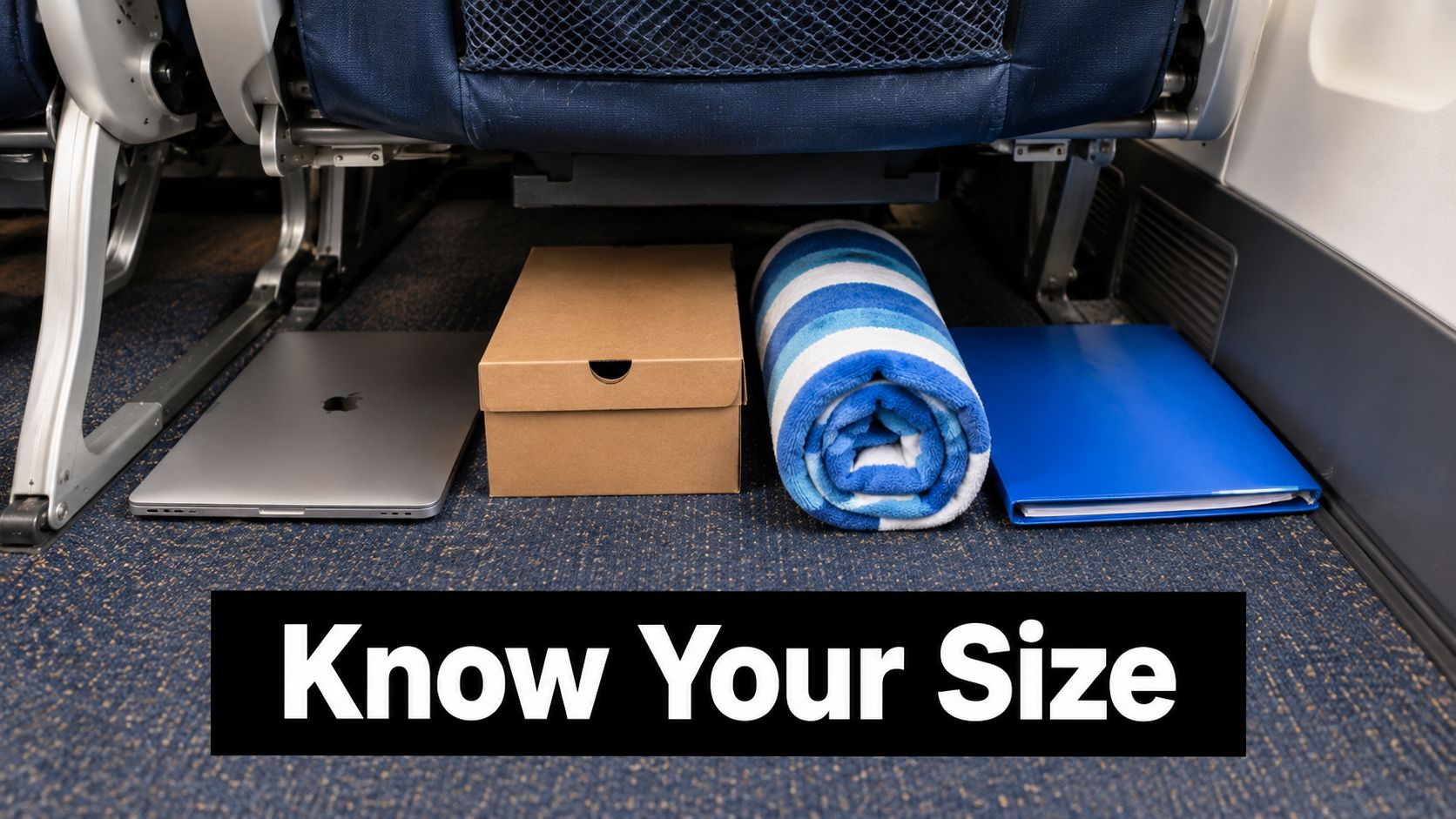
A rolled beach towel is another good test. It may look soft and harmless, but once it sits beside a water bottle and a pouch, it can push the tote's walls outward. The same thing happens with a sweater packed for a chilly cabin. Flexible contents still take up real space.
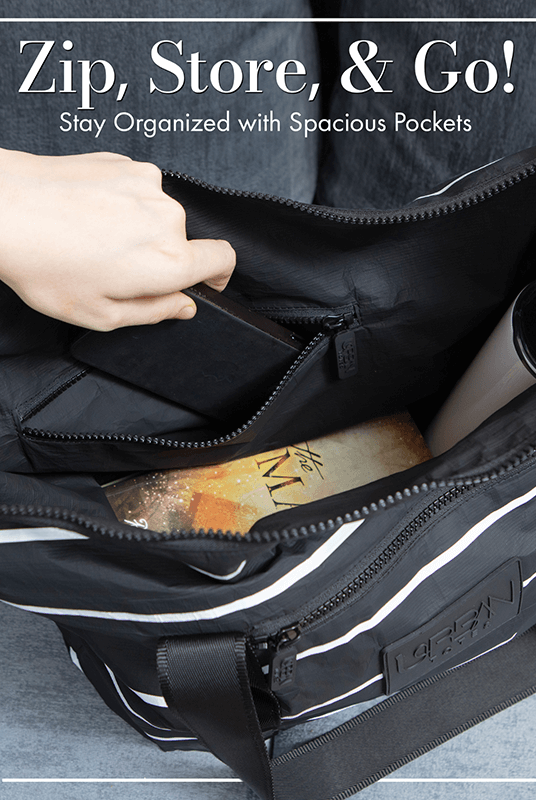
At cruising altitude, the ideal arrangement lets you reach for a paperback, headphones, or snack without pulling the entire bag into the aisle. A multi-pocket tote helps because small essentials stay organized instead of collecting in one dense lump at the bottom.
A slim laptop bag offers a different visual model. It keeps the depth restrained and prioritizes a flat profile, which is why a slim laptop bag can be useful for travelers whose main concern is fitting a computer beneath the seat.
For airport intuition, ask yourself three questions:
- Would the packed bag slide beneath the seat without being forced?
- Can the contents stay below the seat rather than spilling into the footwell?
- Does the bag still have enough flexibility to let you move your feet comfortably?
Those questions matter more than a tote's advertised capacity. A bag that looks generous in a product photo may feel very different once it holds the things you need for the flight.
Why Soft-Sided Does Not Automatically Mean Compliant
Soft fabric helps, but it doesn't perform magic. A tote can collapse beautifully when empty and become nearly rigid after you add a laptop, shoes, a toiletry kit, and a structured packing cube.
The problem is packing density, not just the material. Dense objects create hard zones inside the bag, and those zones determine the shape that meets the aircraft seat. An exterior pocket filled with chargers can push the width outward, while a pair of shoes can make the base thicker than expected.
Advertised liters also don't tell you how the tote behaves when packed. Two bags with similar stated capacity may have completely different usable shapes. One may distribute contents across a broad, shallow base, while the other may bulge in the middle and lose its ability to compress.
A smaller tote with controlled depth can be more dependable than a larger tote filled to its limits.
Pack for access as well as capacity. Place the laptop or tablet flat against a stable side, keep soft clothing near the top, and avoid building a hard wall across the deepest section. If a toiletry kit has a firm frame, position it where it won't determine the entire bag's profile.
A slightly smaller bag can also make the boarding process calmer. You're less likely to wrestle with the seat opening, block your own legroom, or discover that a full tote needs to be gate-checked. Flexible construction still matters, but flexibility only helps where the contents allow it.
The most reliable test is simple: pack the tote exactly as you'll travel, close every zipper, and measure it in that condition. If the bag only fits when empty, it doesn't fit your trip.
Travel-Ready Totes That Fit Under the Seat
At the gate, a tote can look modest until a laptop, shoes, and a packed toiletry kit turn it into a rigid block. That is why a travel-ready bag needs to be judged after packing, not by its empty appearance or advertised capacity.
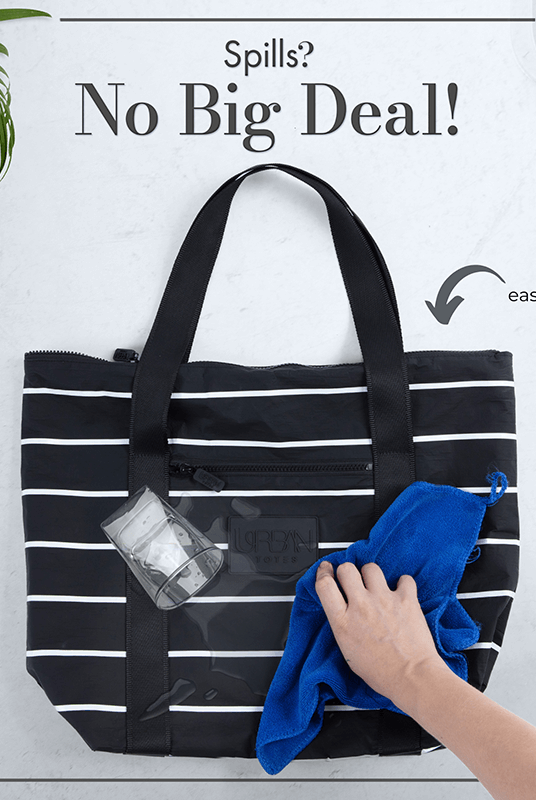
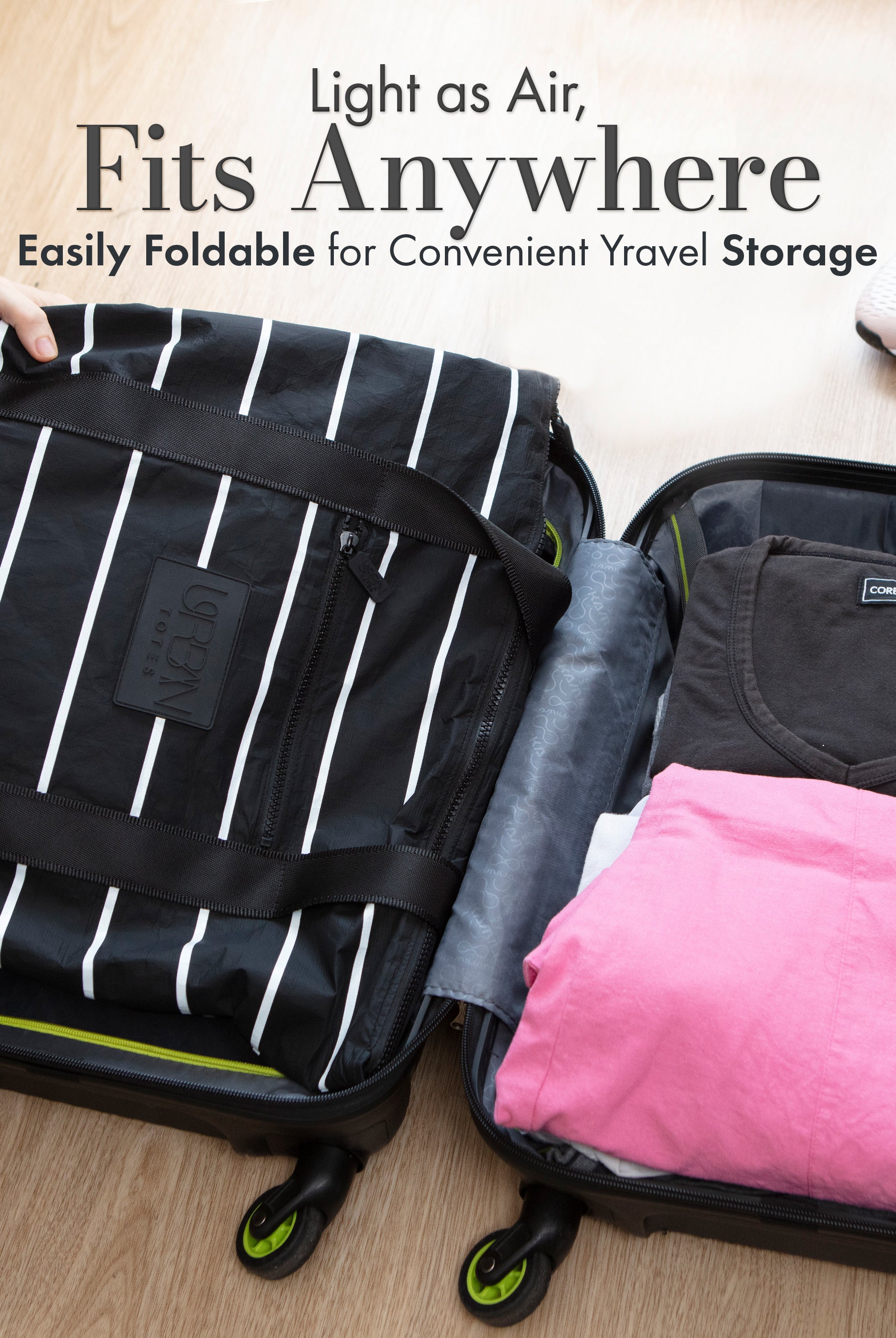
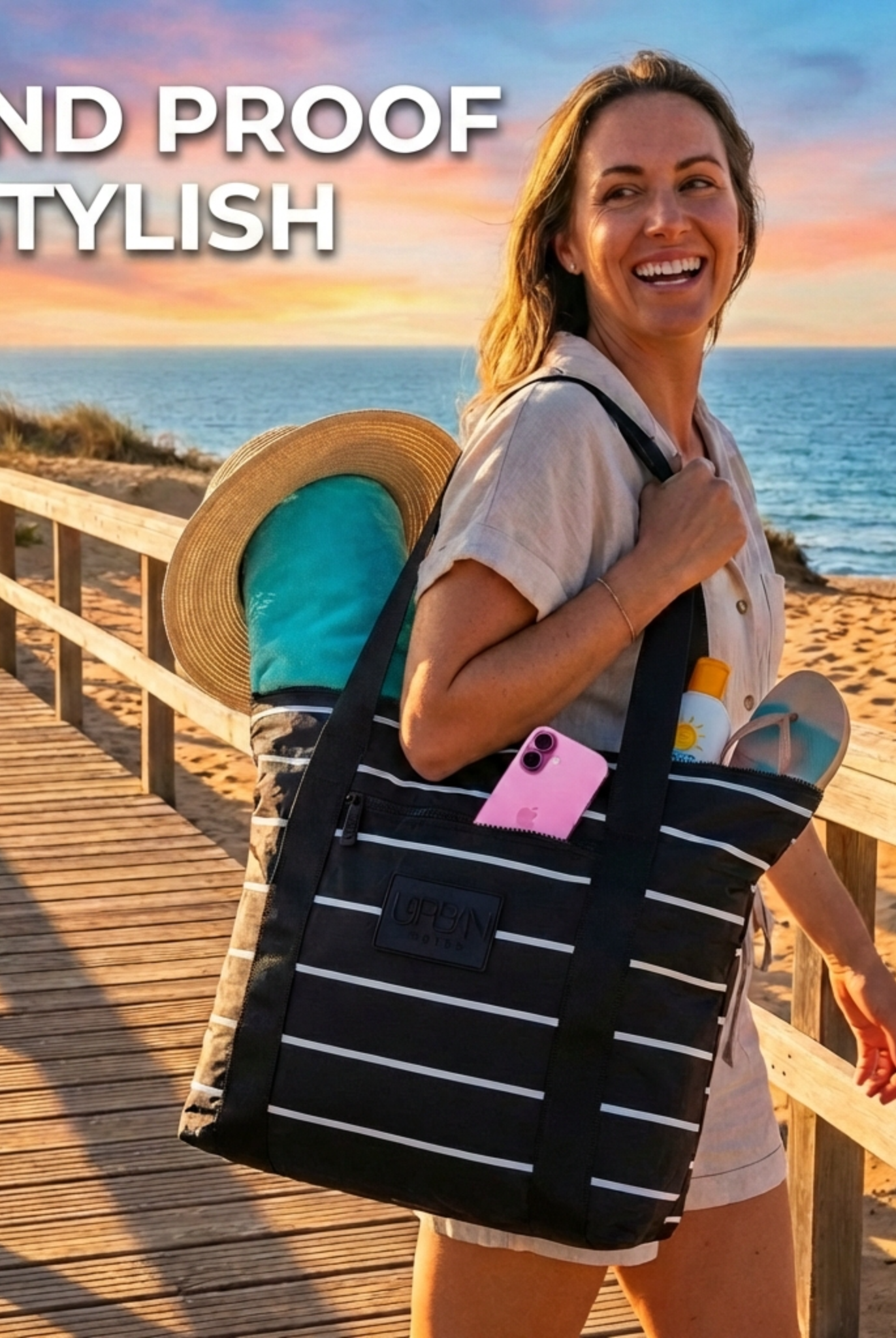
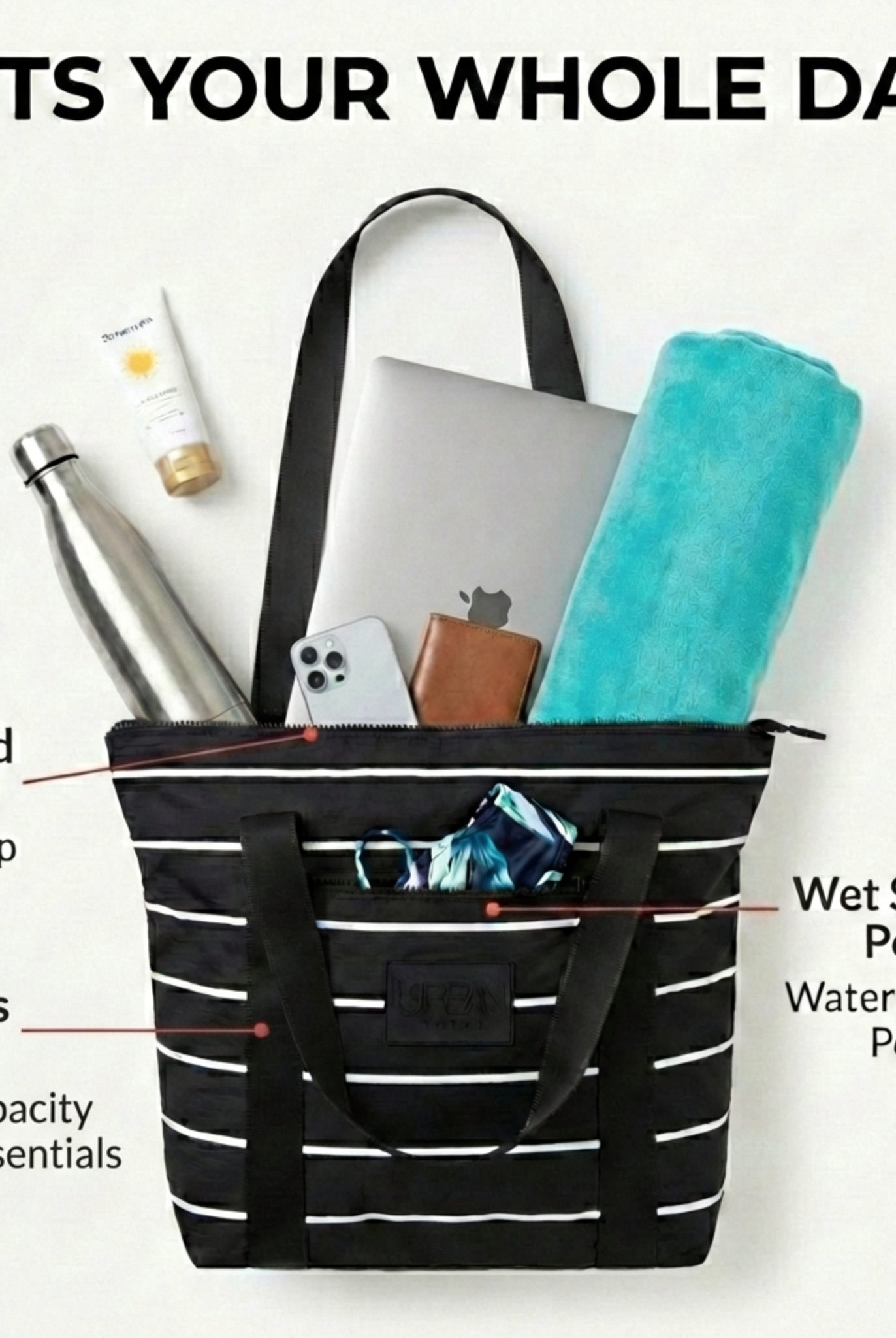
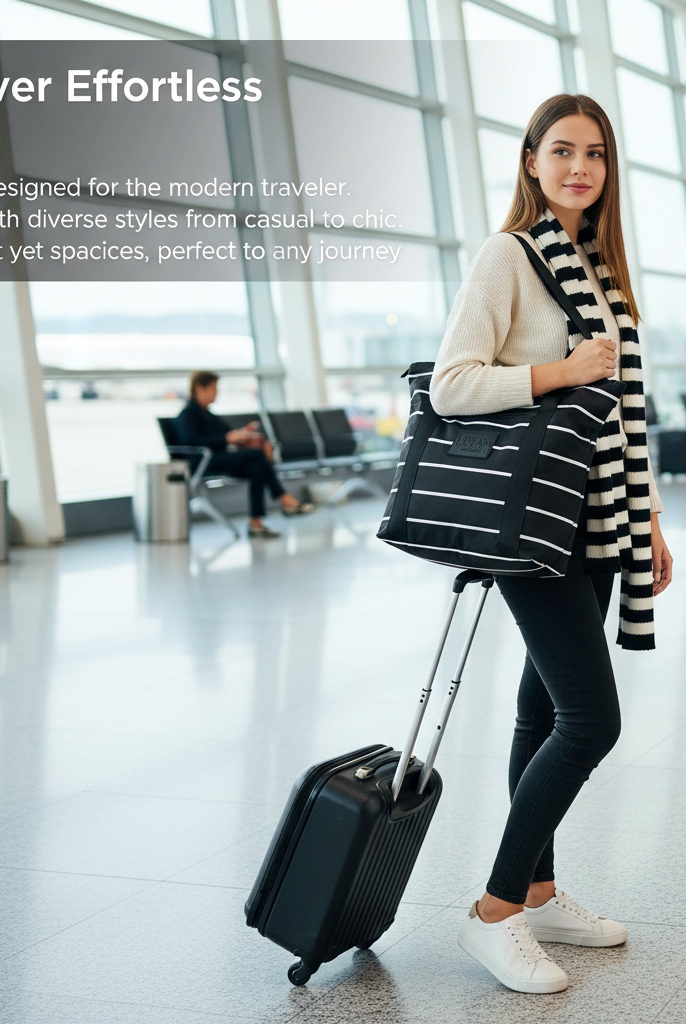
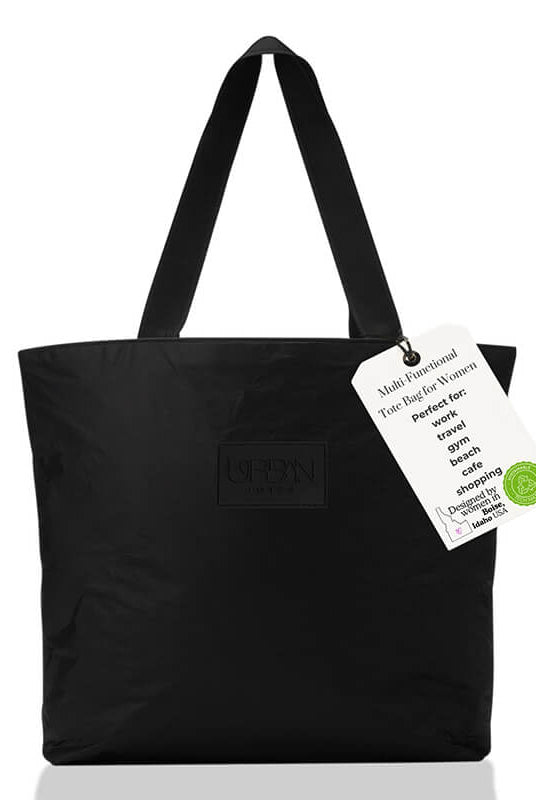
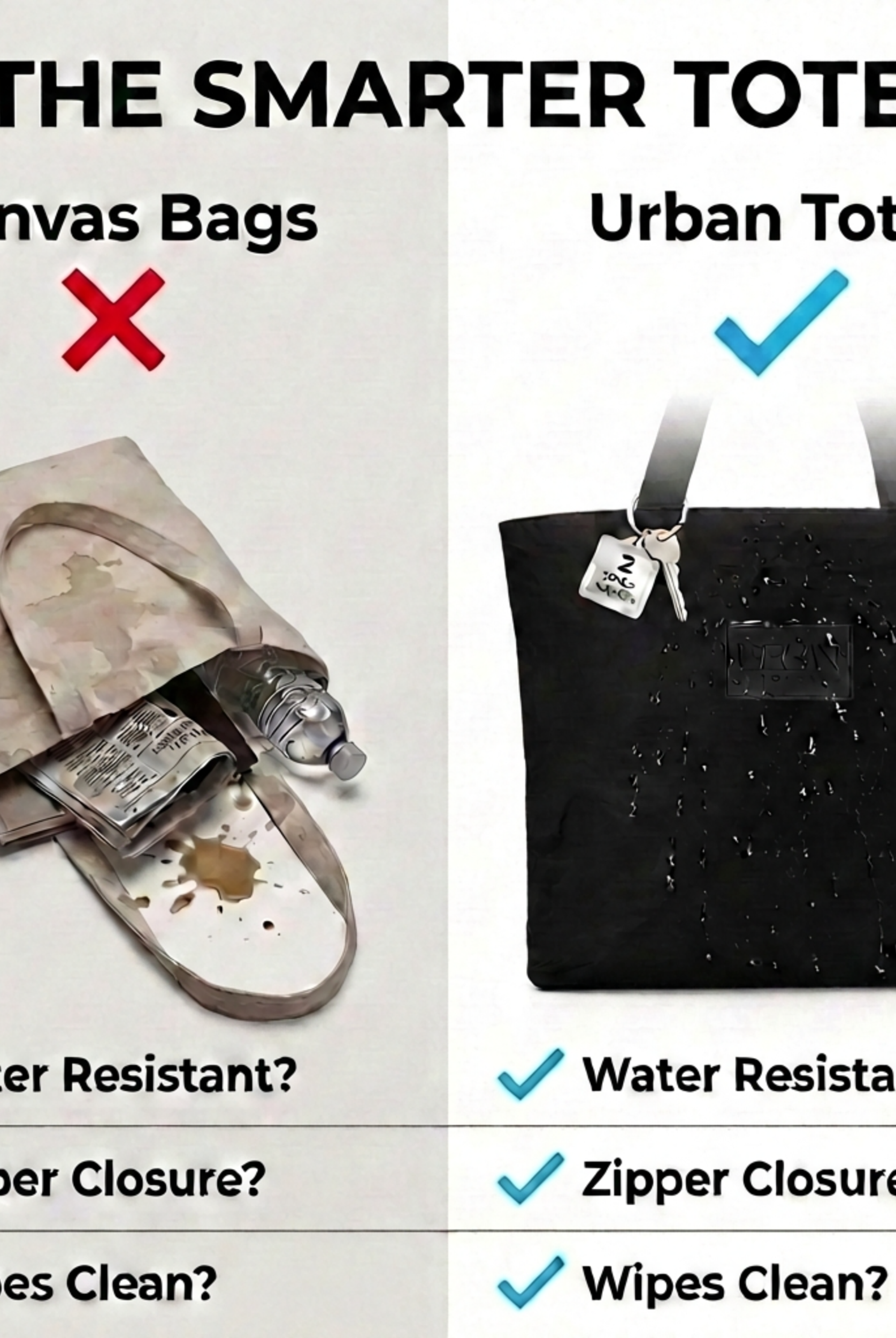
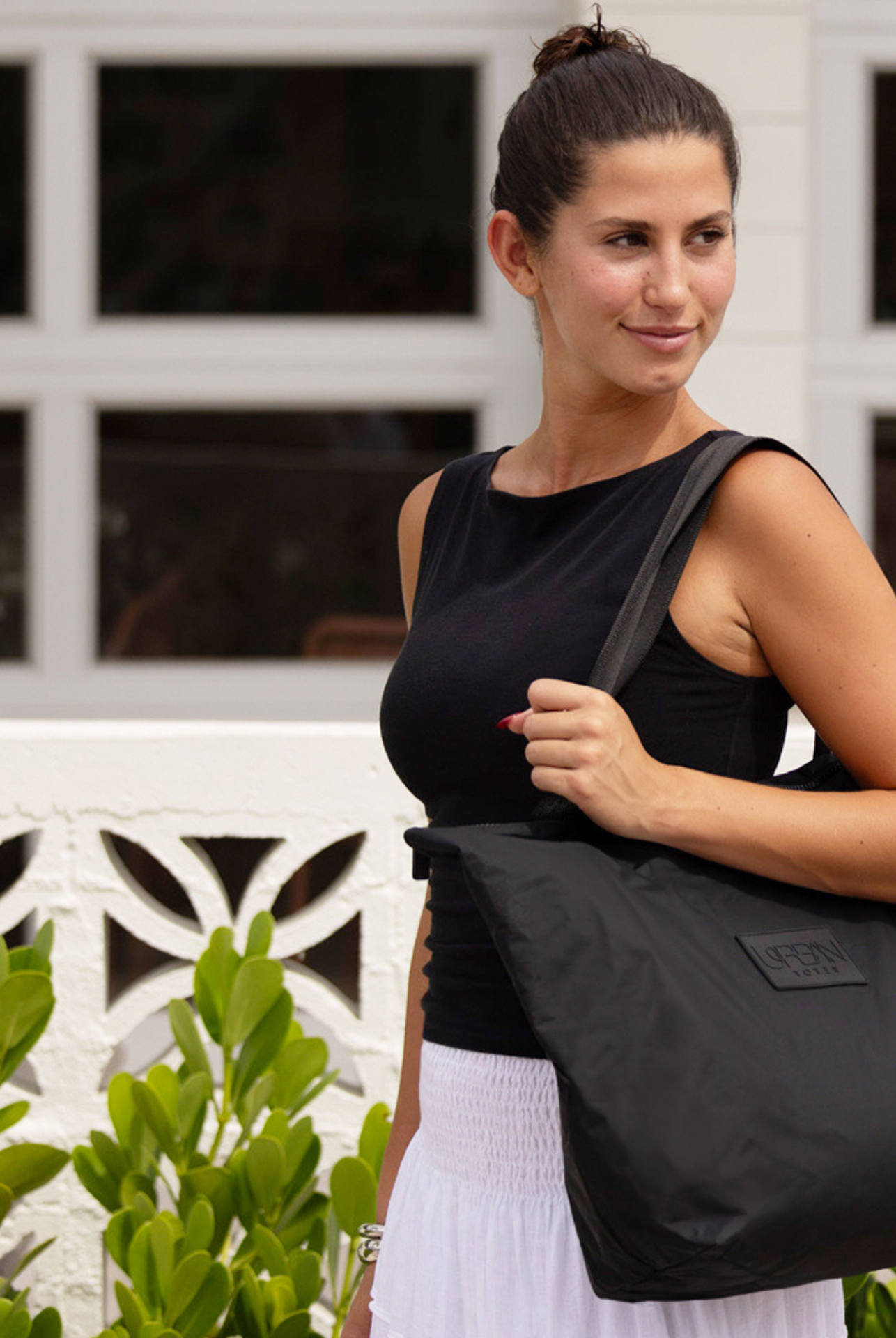
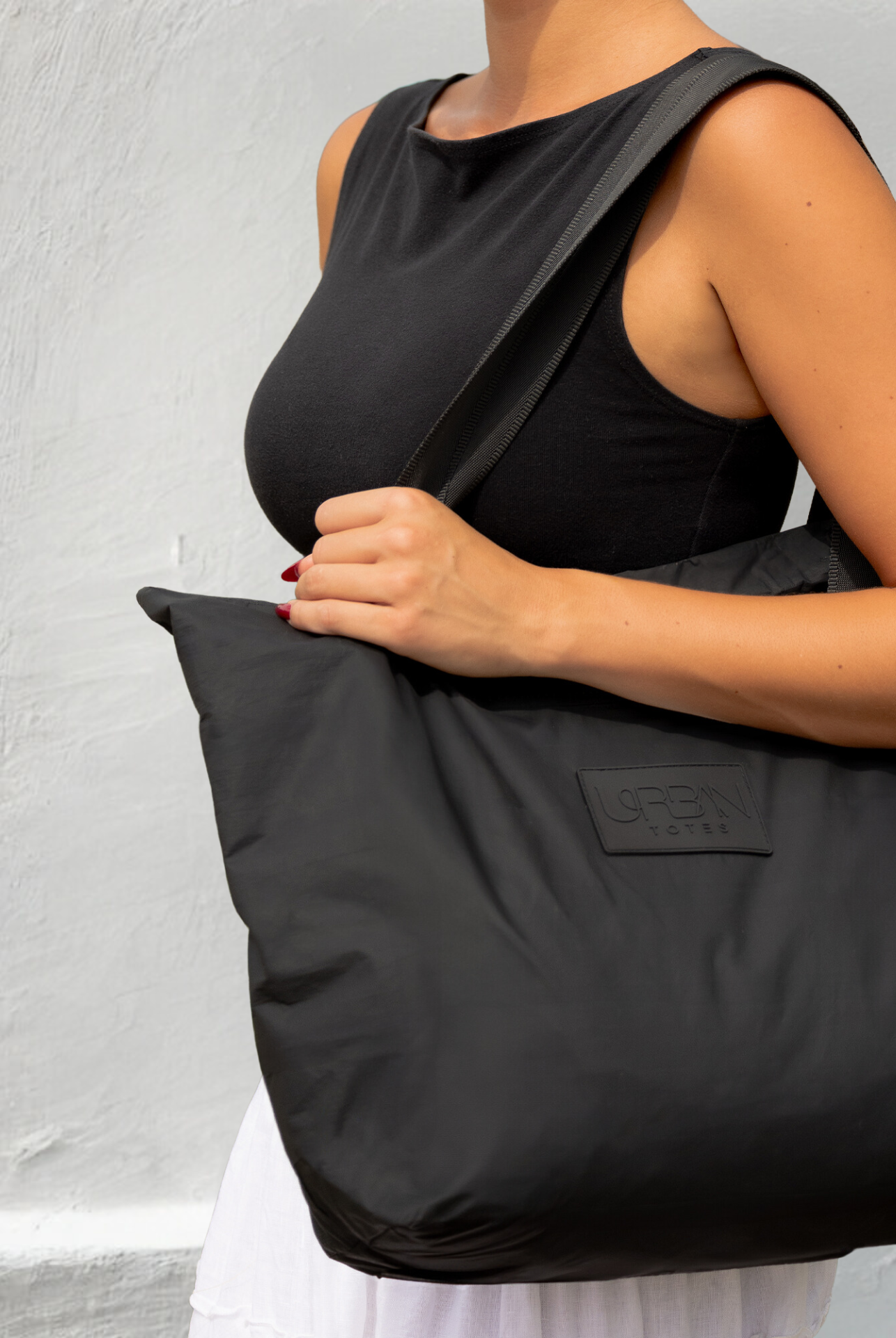
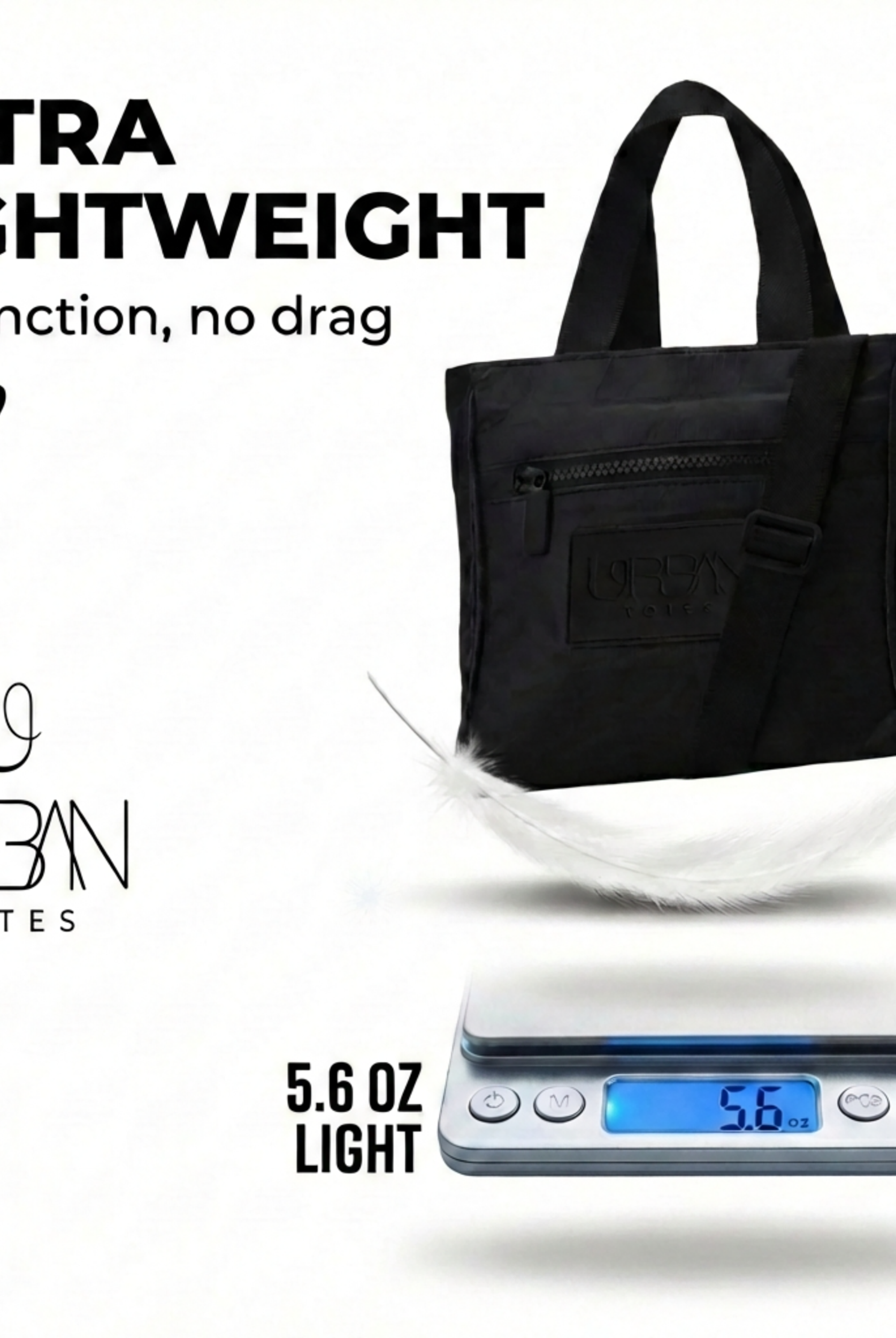
Urban Totes is a woman-owned, Boise-made brand offering bags for travel, errands, beach outings, school pickup, and everyday carry. Its water-resistant, lightweight, packable, and foldable designs suit travelers who want one bag for several parts of a trip.
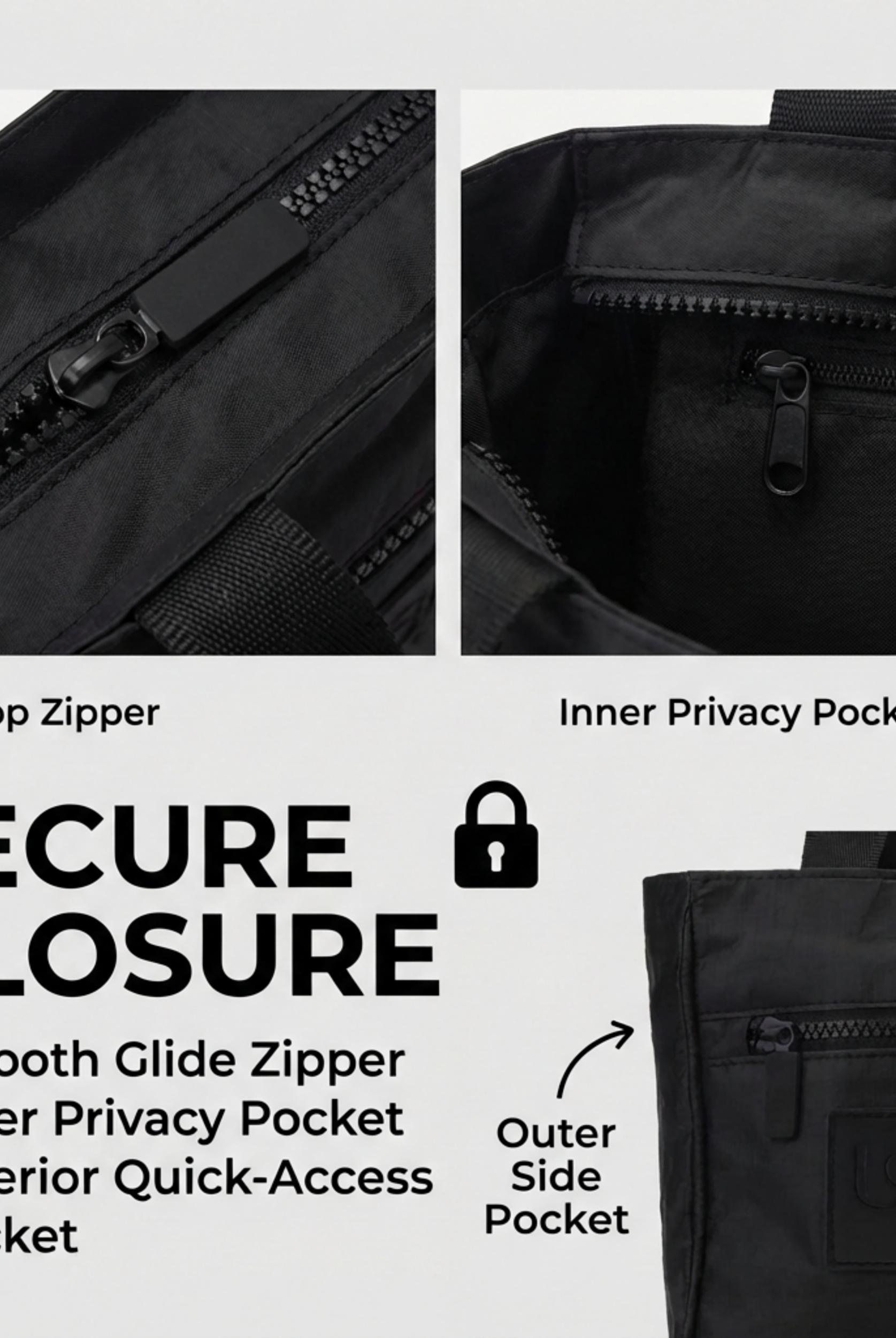
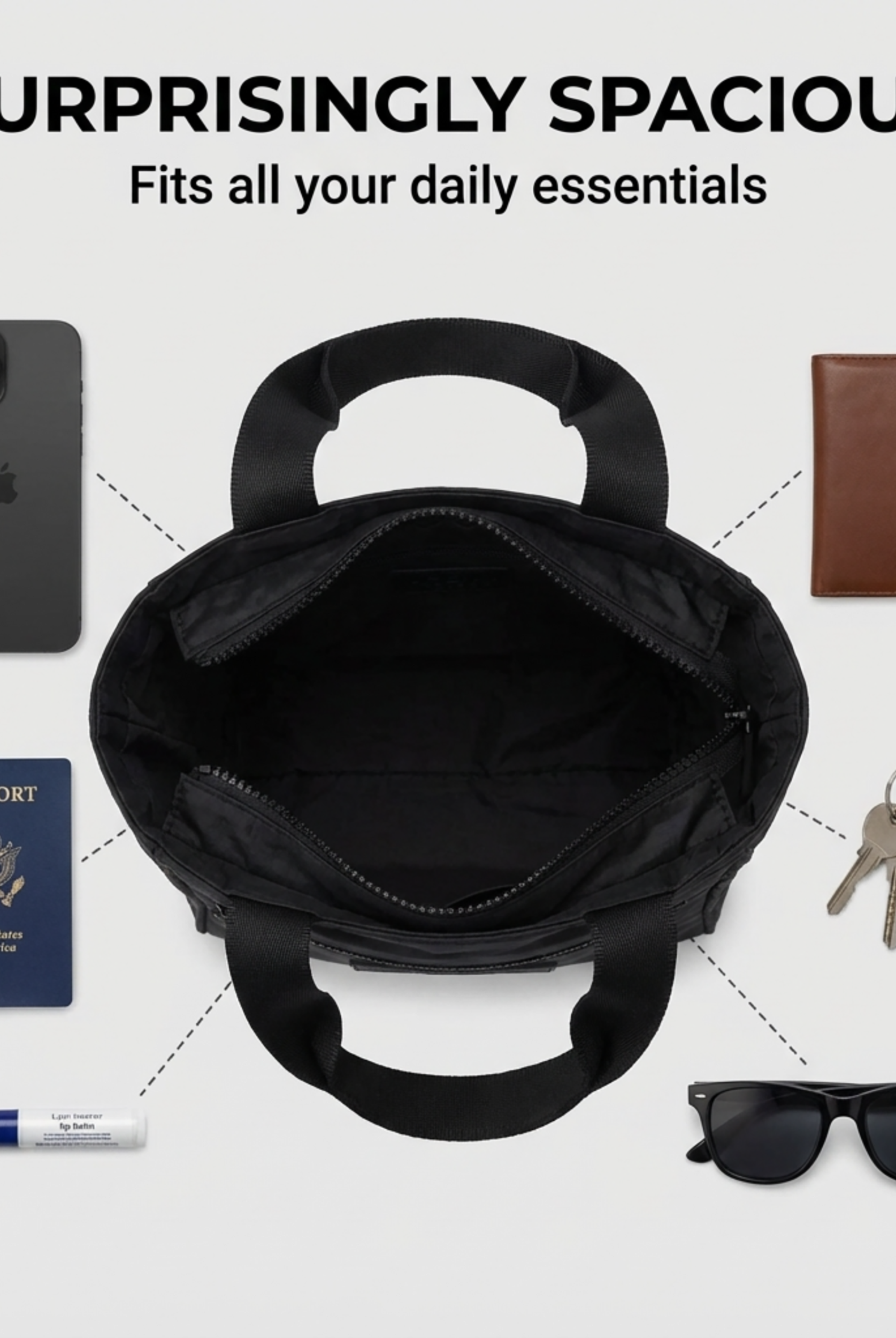
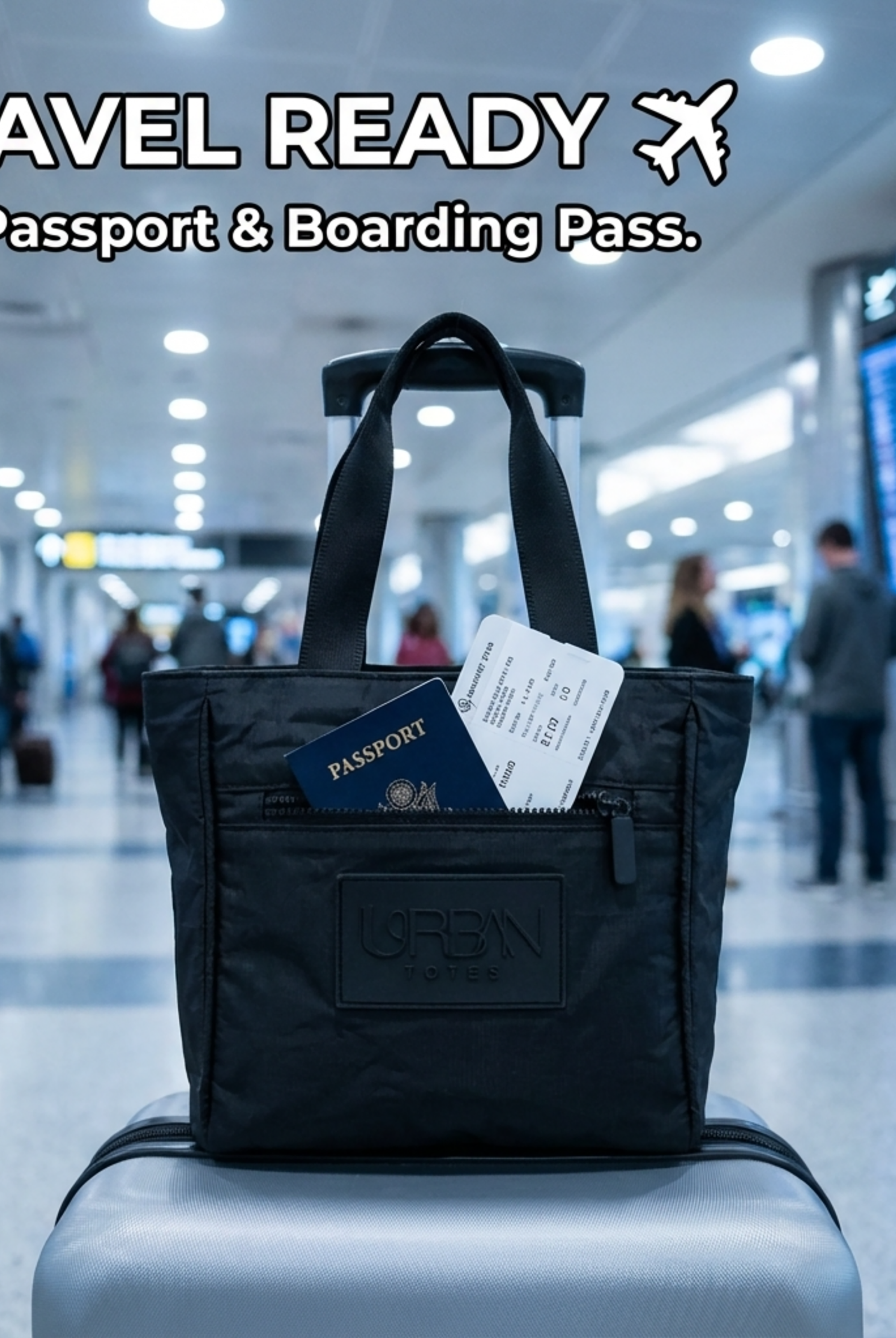
The Crossbody Tote Bag Mini Purse measures 7.5 × 4 × 7.75 inches. That compact profile can hold small items such as a phone, keys, and boarding pass. A zipper closure, outside zipper pocket, inside zipper pocket, and easy-access pocket make retrieval simpler when a larger bag is stored beneath the seat.
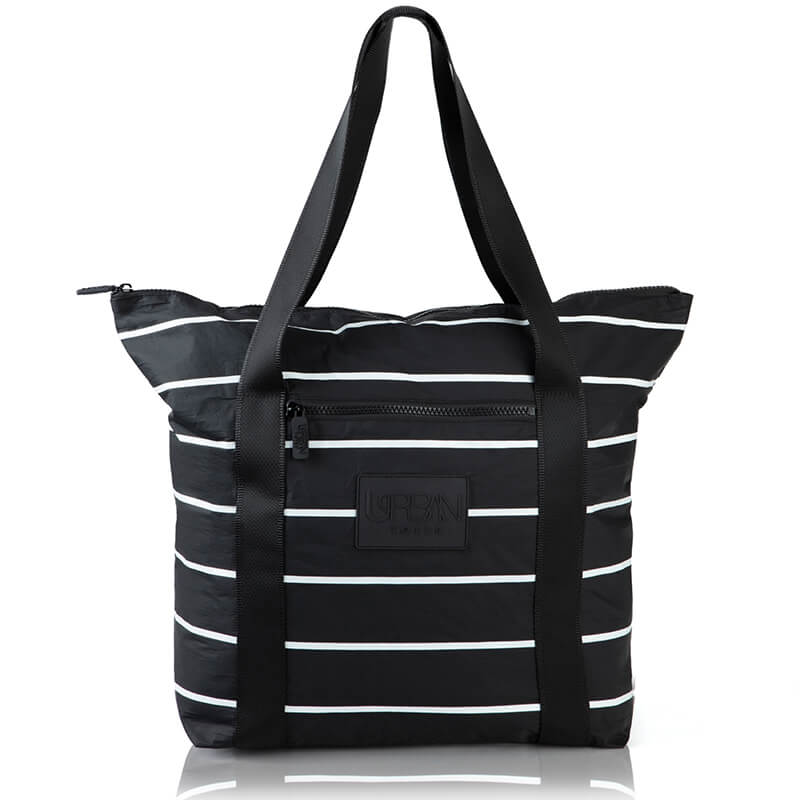
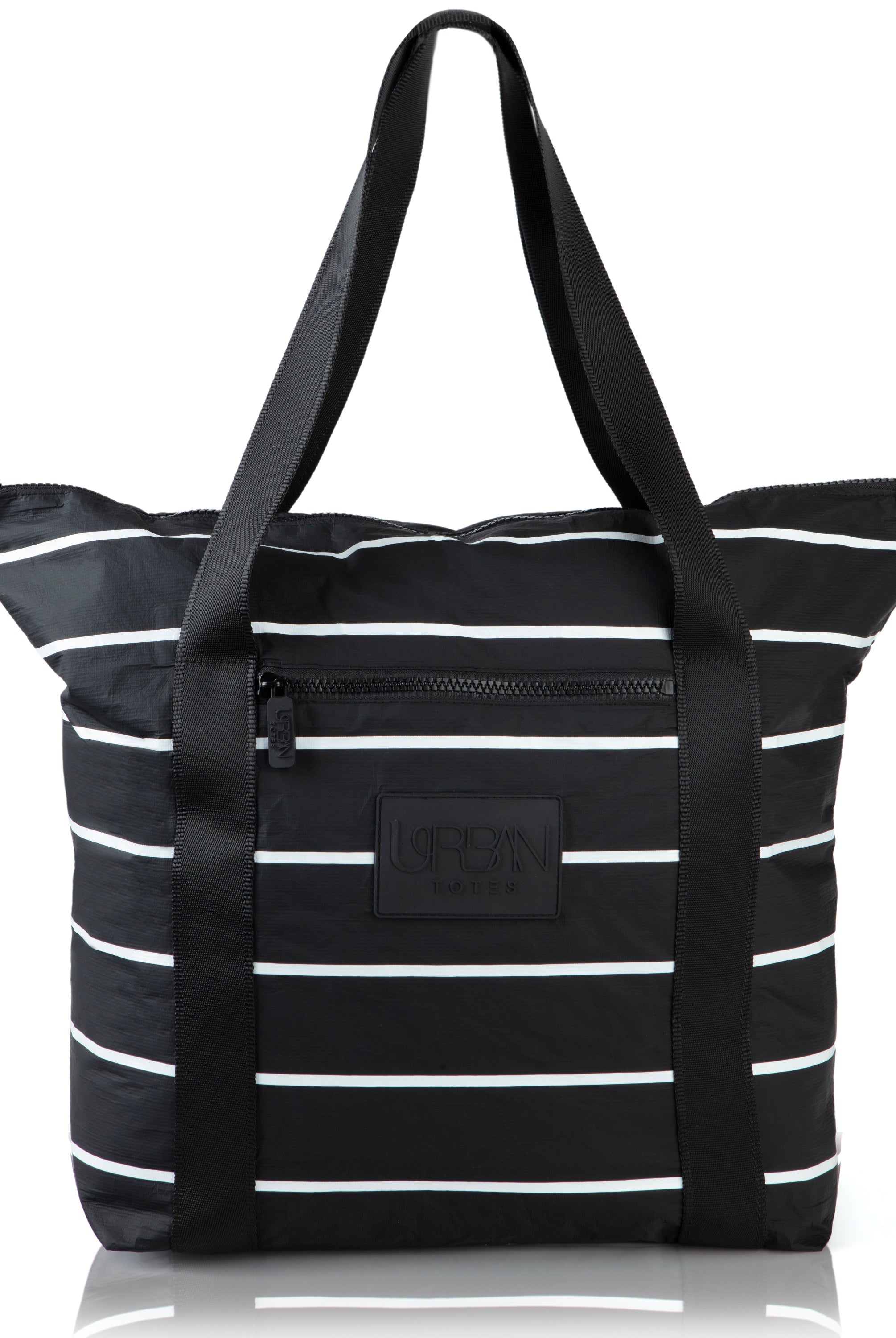
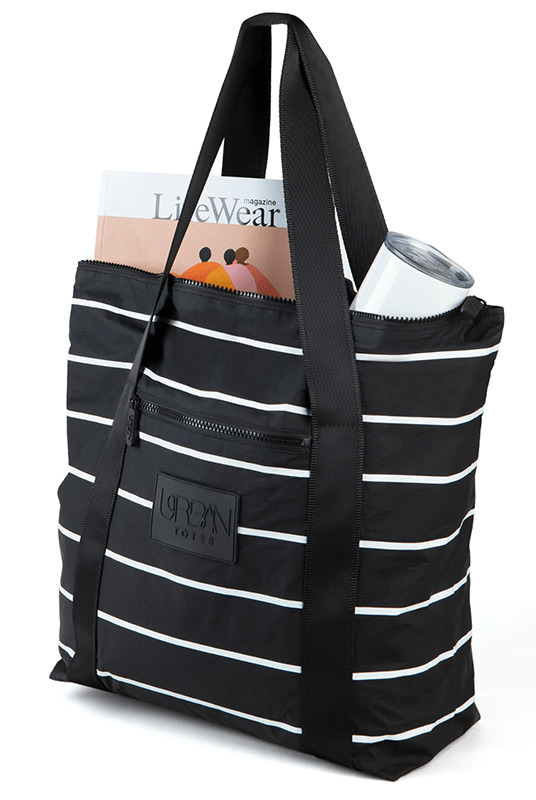
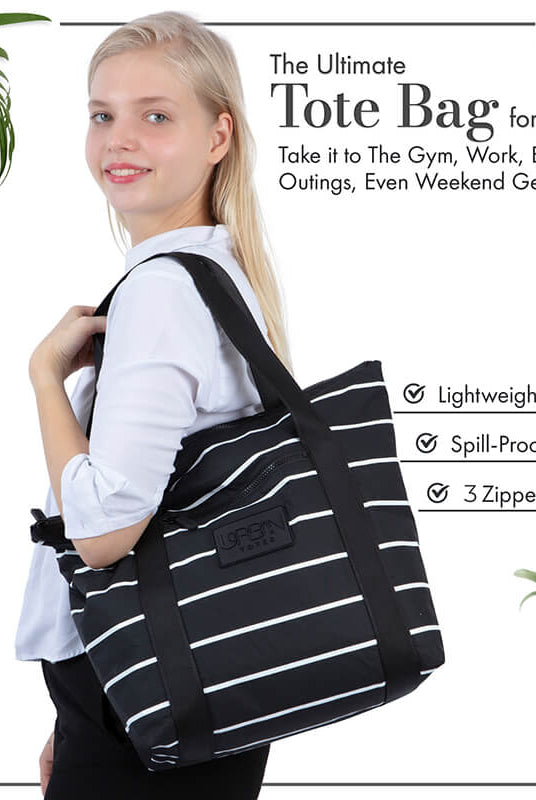
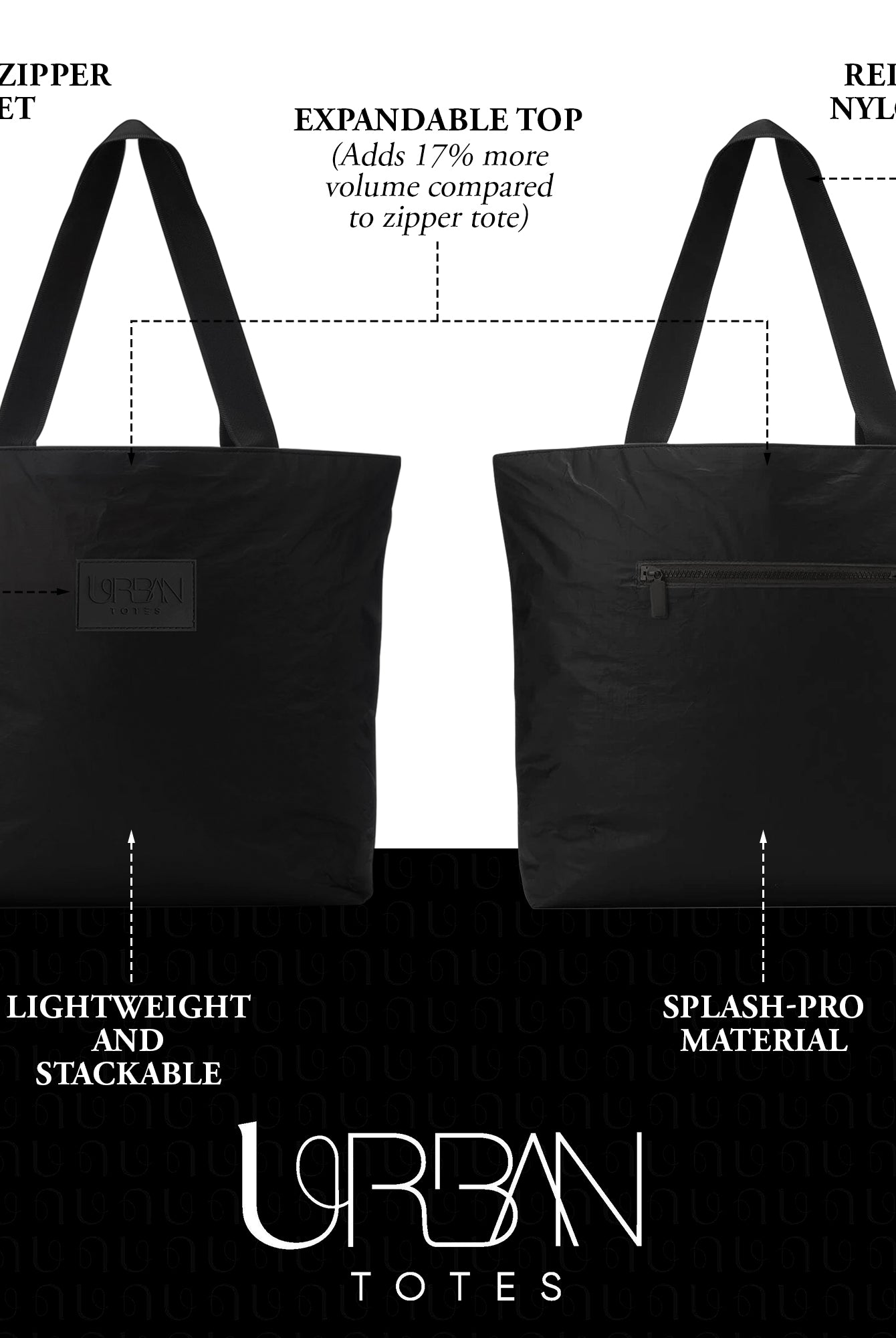
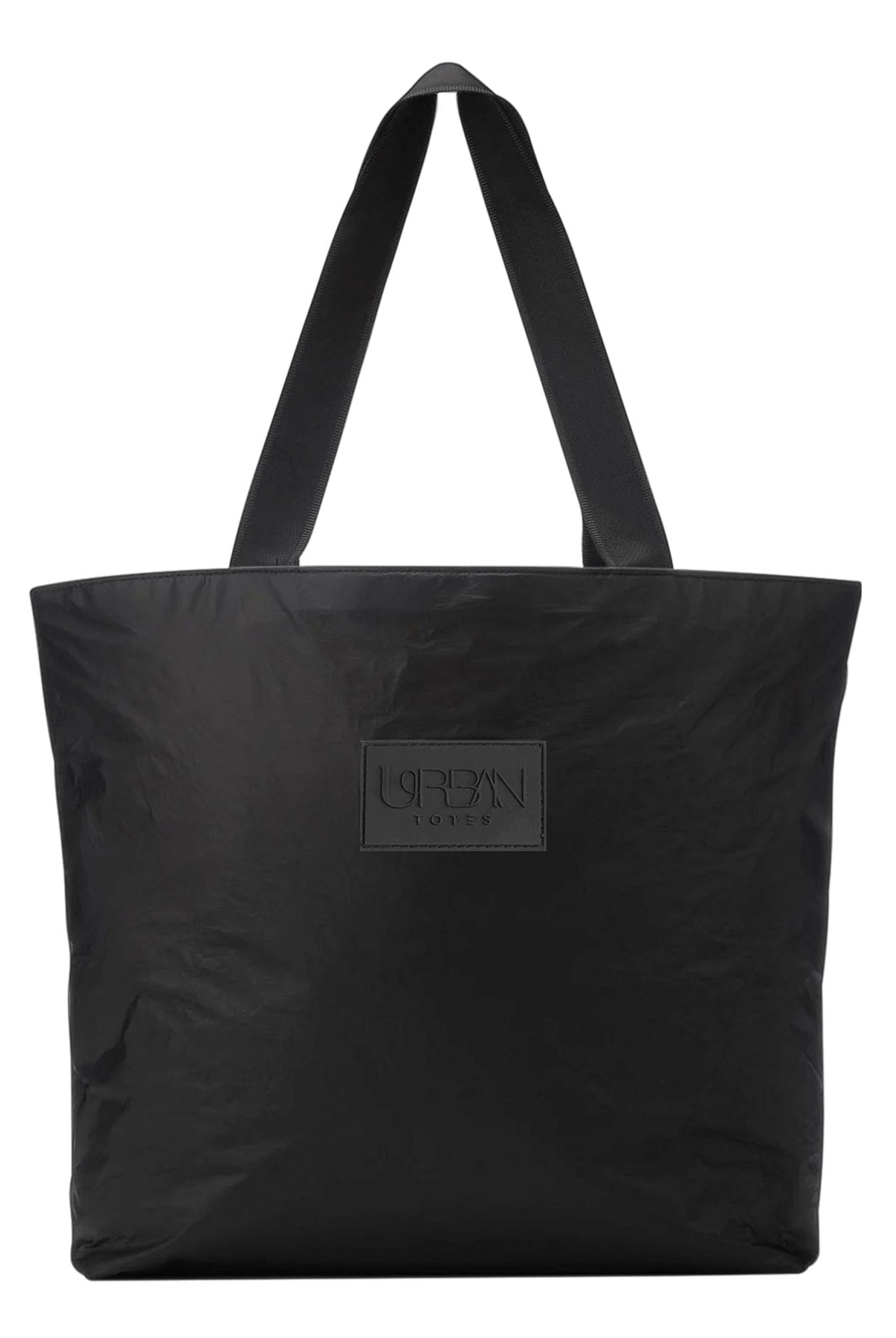
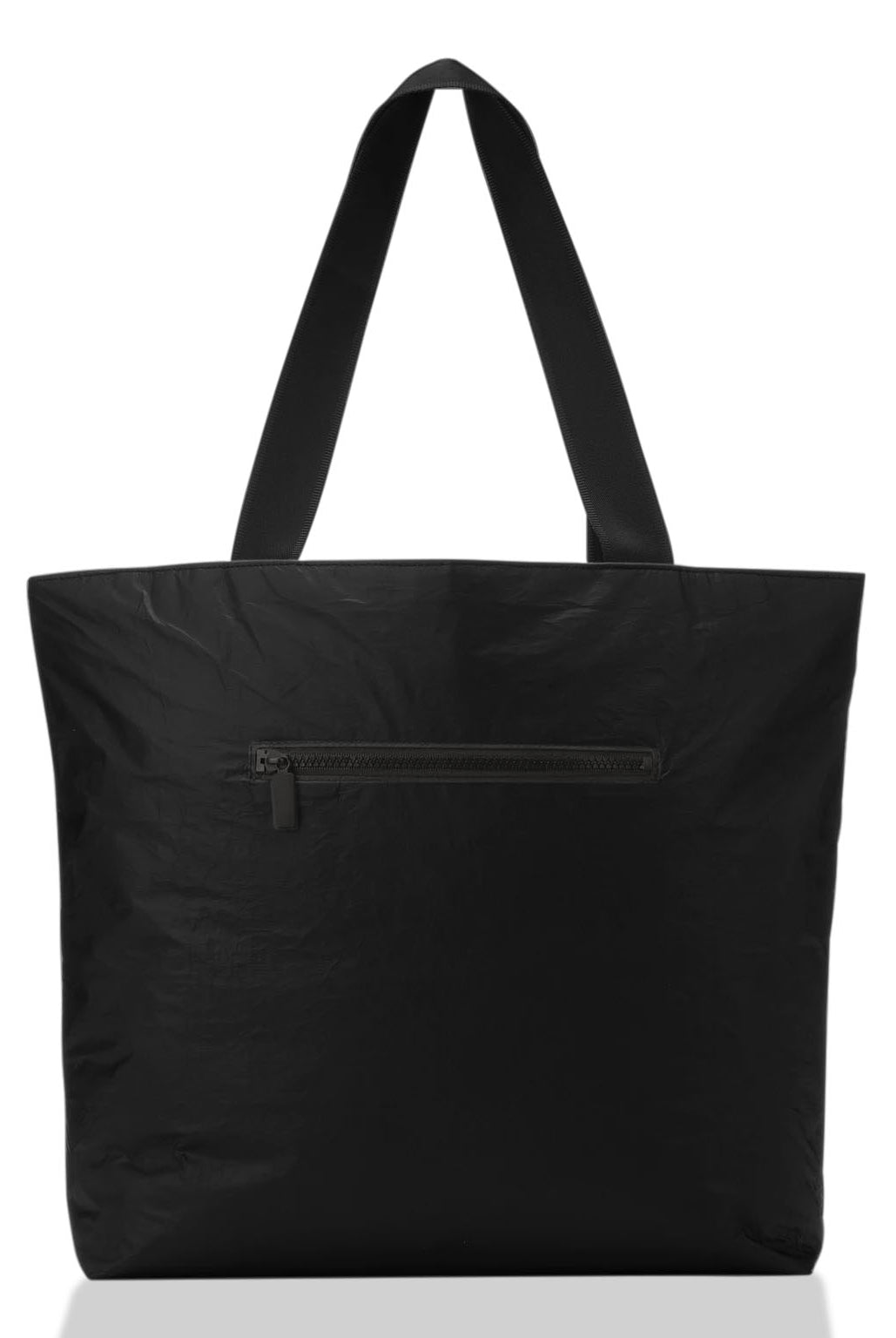
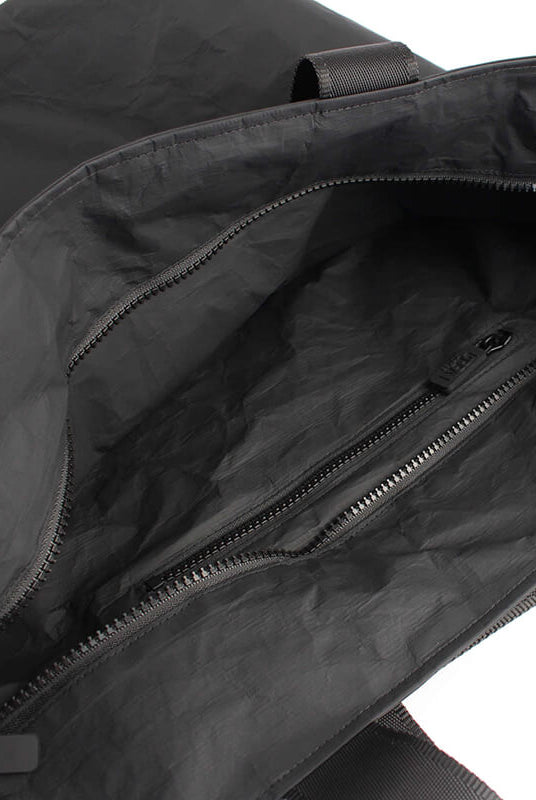
The OG Zipper Tote measures 19 inches wide by 14.5 inches high. Treat it as a carried or packed tote rather than assuming it meets every airline's personal-item limit. Its inside and outside zipper pockets organize essentials, while the lightweight, water-resistant, packable, and foldable construction helps for beach days, weekend outings, or use as a secondary bag.
Airline limits vary, so compare the tote's packed shape with the tightest dimensions on your itinerary. A bag that works for one carrier may be too wide or deep for another.
For more options, browse Urban Totes' guide to best carry-on tote bags, then check each style against the operating airline's personal-item policy.
Pre-Flight Quick Reference and FAQs
Use this short routine before you leave for the airport:
- Check the operating airline: Confirm its personal-item dimensions, especially when your itinerary includes multiple carriers.
- Pack the actual contents: Include your laptop, shoes, toiletry kit, chargers, and anything else that changes the shape.
- Measure the exterior: Check the longest, widest, and deepest points, including pockets, handles, straps, and hardware.
- Confirm the stowage location: The bag must fit fully beneath the seat. The seat-back pocket isn't an approved carry-on location under FAA guidance.
- Leave room to compress: Don't fill every corner if reliable under-seat access matters.
Does a purse count as a personal item
Airline policies determine how multiple bags are treated. A purse, tote, laptop bag, or small backpack may be considered the personal item, so check the carrier's wording before assuming you can bring both a full tote and a separate purse.
What happens if the bag doesn't fit
A bag that fails the airline's sizing frame or can't slide beneath the seat may need to be moved to the overhead compartment, checked, or repacked. The outcome depends on the airline, fare, available space, and staff decision, so measuring at home is less stressful than negotiating at the gate.
Do bulkhead seats have the same under-seat storage
Bulkhead rows can have different storage arrangements because there may be no seat directly in front of you. You might need to place the personal item overhead during takeoff and landing, even if it normally fits under a seat elsewhere in the cabin.
Should you choose the largest permitted tote
Not necessarily. A slightly smaller, soft-sided, organized tote often gives you more dependable access than a maximum-size bag packed until its walls become rigid. Choose the smallest size that holds your essentials comfortably, then verify it against the airline's current rule.
Urban Totes offers water-resistant, lightweight, packable, and foldable totes and compact crossbody styles for travel, errands, beach days, and everyday carry. Explore the organized, zipper-closed collection at Urban Totes, and choose a go-anywhere bag that helps you tote everything with confidence.